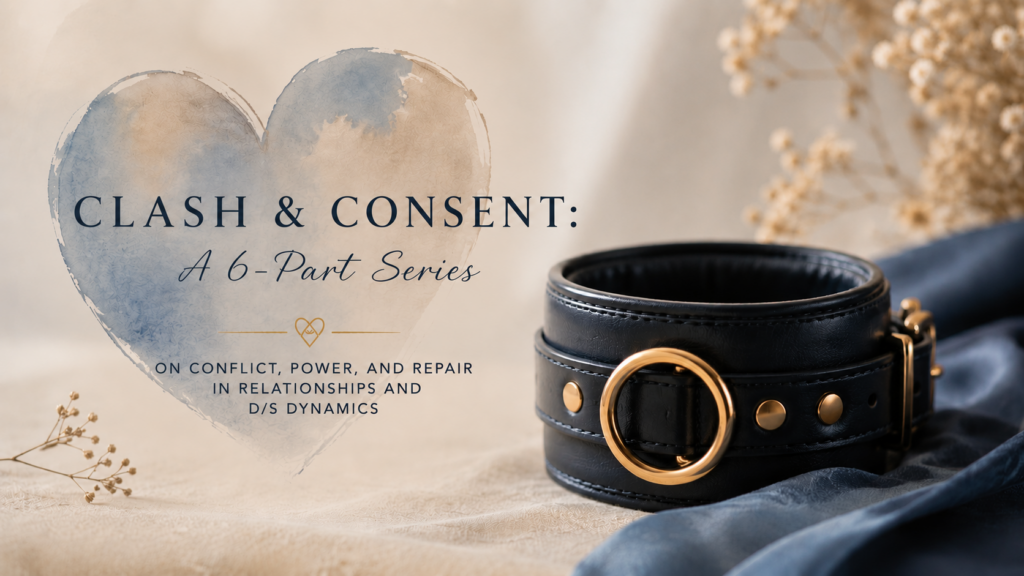
Welcome to Clash & Consent.
I created this series because conflict touches every relationship. Whether you are in a vanilla partnership or living in a D/s or power exchange dynamic, arguments are part of being human. They do not have to destroy connection. With the right understanding and tools, they can actually bring you closer.
Over six weeks we explore how conflict shows up, why it feels different in power exchange relationships, and most importantly, how to repair it in healthy, practical ways. You will find real stories, side-by-side comparisons, usable rituals, and honest guidance on when to keep working and when to protect yourself.
This series is for anyone who wants relationships that feel safer, deeper, and more honest.
The Full Series
- The Universal Language of Conflict: How Arguments Happen in Every Relationship
We start with the basics. What conflict really is, why it is inevitable, and the common triggers we all face. - Power, Protocol, and Pain: What Conflict Looks Like Inside a D/s Relationship
We step into D/s dynamics and explore how power exchange, headspace, and protocols change the shape of conflict. - Same Fight, Different Rules: How Conflict in D/s Compares to Vanilla Relationships
A clear side-by-side look at what stays the same and what feels very different once power exchange is involved. - Repair Rituals That Actually Work: Conflict Resolution for Vanilla and D/s Couples
Practical tools, including Dr. Anthony Ferraioli’s LVAC method, a six-step repair process, and D/s-specific rituals. - Real Stories, Real Fixes: Case Studies of Conflict and Resolution
Three honest, anonymized stories from couples who faced real struggles and found their way through. - When Conflict Turns Toxic: Knowing When to Stay and When to Walk Away
The harder conversation. Red flags, emotional competence, and how to make loving choices for your well-being.
Your Free Companion Resource
Download the Conflict Repair Toolkit – a printable PDF full of worksheets, scripts, checklists, and rituals designed for both vanilla and D/s relationships. Use it alongside the series or on its own.
[Download the Conflict Repair Toolkit Here]
Start the Series
Ready to begin? Start with Post 1 → The Universal Language of Conflict
I hope these posts give you new language, practical tools, and the reassurance that you are not alone in this work. Conflict does not mean something is broken. It means you care enough to figure it out.
Leave a comment below and tell me what brought you here or which topic you are most looking forward to. I enjoy hearing your thoughts.
Thank you for being part of this series.
Here’s to healthier conflict and deeper connection.
Michele